€0.00
Checkout


€10.89
 Shipping to United States from €47.27
Main Specifications
Condition (used, new):
New
Type:
Set of PEEK rings
Installation location:
Input shaft
Quantity per transmission:
3
If you order more than 29 pcs - shipping time will be longer at few days
| Stock Place: | Availability: | Qty: |
| Slovakia | 29 pcs. |
  |
| Ukraine | 67 pcs. |
|
- Product overview
- Shipping & Payment
- Questions - Answers (0)
- Thickness - 1.70 mm;
- Outer diameter - 28.50 mm;
- Inner diameter - 35.20 mm;
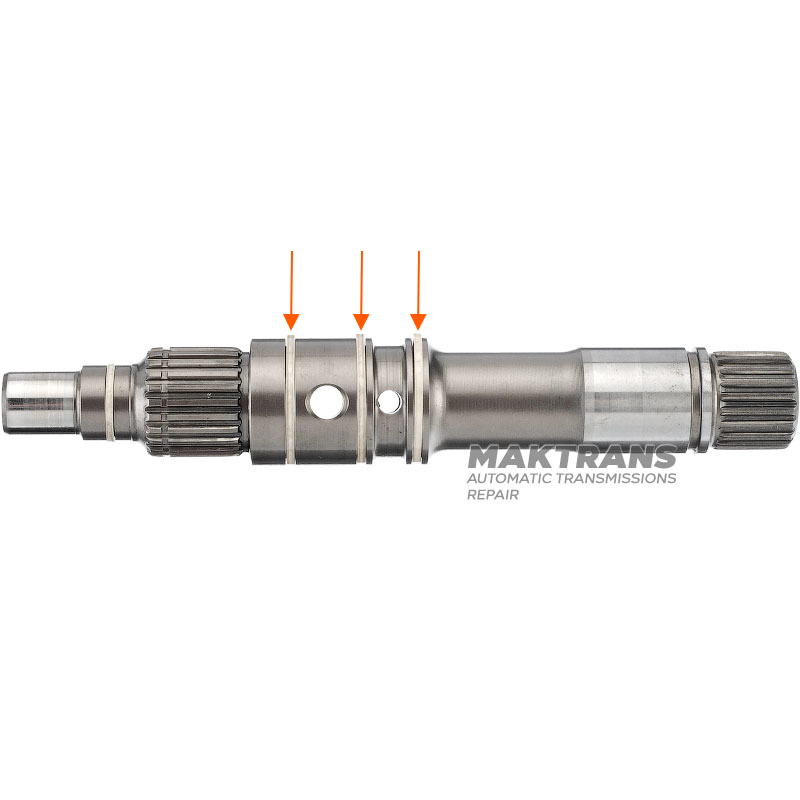
PEEK (Polyetheretherketone) is a high-tech semicrystalline thermoplastic classified as a super-engineering polymer. In industry, particularly in hydraulics, oil and gas, and automotive applications (e.g., transmission components), PEEK sealing rings are used where standard materials cannot withstand extreme loads.
What are PEEK seals?
Unlike soft elastomers or Teflon, PEEK is a rigid, highly durable material. O-rings made from it are often made as protective (anti-extrusion) rings or rigid dynamic seals. They retain their mechanical properties at temperatures at which other plastics begin to melt or deform.
Advantages of PEEK over Teflon (PTFE) O-rings
Although Teflon (PTFE) is renowned for its record-low coefficient of friction, it has significant drawbacks that PEEK successfully eliminates:
1. Resistance to cold flow (creep)
-
PTFE: Under constant load, Teflon has the tendency to "leak" out of the gap or deform over time, even at room temperature.
-
PEEK: Possesses tremendous rigidity and dimensional stability. It does not deform under high pressure, making it ideal for use as support rings.
2. Mechanical strength and wear resistance
-
PTFE: Easily scratched and worn by abrasive particles.
-
PEEK: Extremely resistant to abrasion and mechanical damage. Its tensile strength is significantly higher than that of Teflon.
3. Working at ultra-high pressure
Thanks to its hardness, PEEK can withstand pressures that would simply squeeze a Teflon ring into the gaps between components (extrusion effect). This is critical for deep-sea equipment or high-pressure hydraulics.
4. Temperature stability
Although both materials are chemically resistant, PEEK maintains structural integrity at temperatures up to 250°C (and briefly higher), while Teflon becomes too soft to perform load-bearing functions at high temperatures.
Comparison table
| Teflon (PTFE) | PEEK plastic | |
| Coefficient of friction | Extremely low (best) | Short |
| Rigidity | Low (flexible) | High (hard) |
| Pressure resistance | Medium/Low | Very high |
| Chemical resistance | Almost absolute | Excellent (almost at the level of PTFE) |
| Wear resistance | Moderate | Very high |
![Gear with output shaft RE4F03A RL4F03A RE4F03B RE4F03V / 3148031X02 3140931X02 / [52 teeth, outer Ø 111.70 mm]](https://maktrans.net/image/cache/catalog/easyphoto/30589/shesternya-s-vyhodnym-valom-re4f03a-rl4f03a-re4f03b-re4f03v-3148031x02-3140931x02-52-zuba-nar-111-70-mm-1-228x228.jpg)
![Oil pump drive gear GM 8L45 / [39 teeth, outer Ø 76.70 mm]](https://maktrans.net/image/cache/catalog/easyphoto/29478/vedushchaya-shesternya-privoda-maslyanogo-nasosa-gm-8l45-39-zubev-nar-76-70-mm-1-228x228.jpg)